

Published On: October 15, 2026 Categories: News

Curtains get dirty so gradually that most people never see it happening. The eye adjusts along with the fabric, and it often takes a visitor, a house move or a sunny afternoon at the wrong angle to make it obvious.
So rather than waiting to notice, it helps to work to a schedule. Here is a practical answer to how often curtains should be cleaned, and the things that shift the timing either way.
For a typical household with ordinary use, no smokers indoors and no particular sensitivities, every two years is a sensible interval for lined curtains and heavy drapes.
Sheers want attention more often, roughly every twelve to eighteen months. They sit closest to the glass, catch the airborne dust first, and because light passes through them they display soiling long before a heavy drape looks dirty.
●Several circumstances shorten the interval considerably. Consider annual cleaning if any of these apply:
●Someone in the home has asthma, hay fever or a dust allergy
●You live on a busy road, a tram route or beneath a flight path
●The kitchen is open plan and curtains sit within reach of cooking
●Anyone smokes indoors
●You are close to the bay and get salt-laden air
●Pets shed, or a cat has claimed the windowsill
Close the curtains at the end of a warm day and have a proper sniff. Heat brings out whatever the fabric has absorbed, and a stale or cooking-like odour means there is soil in the weave.
Give a curtain a firm shake near a sunlit window. A small puff is normal. A visible cloud hanging in the light is not.
Look at the vertical edge that sits exposed when the curtain is open. If it differs noticeably in colour from the fabric that stays folded behind it, you are seeing accumulated soil, sun fade or both.
Dirt and moisture settle at the bottom. Grey along the hem, or spotting on the lining near floor level, usually means condensation has been sitting there through winter. That is how mould gets started.
This part is less obvious than it should be.
Household dust is not soft. Much of it is abrasive, made up of grit, sand, skin and fibre. Every time a curtain is drawn, those particles move against the fibres and cause tiny amounts of wear. The dirtier the curtain, the faster that wear accumulates.
Add strong sunlight to the equation and it accelerates further, since soiled fabric absorbs more heat and degrades faster than clean fabric under the same conditions. A curtain maintained sensibly can last decades. The same curtain left for a decade between cleans tends to go brittle along the sun-facing edge and split at the leading hem.
Cleaning curtains is maintenance rather than decoration. It is the difference between replacing them once and replacing them twice.
Spring pollen coats everything from late August onwards, so getting ahead of it helps anyone in the house who suffers.
Hot, dry northerly winds through summer carry a surprising amount of fine dust straight through open windows.
Winter is the one that causes lasting damage. Cold glass plus a warm room produces condensation that runs down onto the curtain hem and stays there behind a closed curtain for months. This is the leading cause of mould in Melbourne curtains, and it is worth inspecting hems each spring.
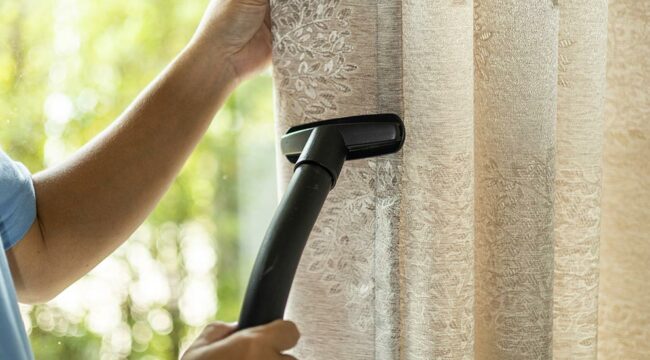
Vacuum them twice a year with a brush attachment on low suction, working from the top down. It takes about ten minutes per room and removes a considerable amount of abrasive dust before it settles into the weave.
Open windows on dry days, since airflow does more for fabric than most people expect. Keep an eye on hems through the colder months. And always check the care label before attempting any spot cleaning at home.

Lined and interlined curtains, blockout fabrics, silk, wool and anything difficult to reach are best handled professionally. If you have found mould at the hem, that needs treating rather than simply washing, and the sooner the better.
Dr Drapes takes curtains down, cleans them at a purpose-built plant and rehangs them, so the whole job costs you a phone call and being home twice.
Do curtains in unused rooms still need cleaning? Yes, though less often. Dust settles regardless of use, and closed rooms tend to hold moisture, which is a mould risk.
Does vacuuming replace proper cleaning? No. Vacuuming removes loose surface dust and extends the interval, but it cannot lift oils, odour or soil that has worked into the fibres.
Should sheers and drapes be cleaned at the same time? It is usually easier, since both are down and the room is clear. They generally need different handling once they reach the plant.
Can I clean just one room at a time? Absolutely, and it is a sensible approach if privacy while the curtains are away is a concern.
Still unsure how often should curtains be cleaned in your particular home? Get in touch with Dr Drapes for a quote and we will tell you what yours need.
Recommended by Companies We Work With


Use the form below to drop us an email if you have any question or comments.

 1300 652 866